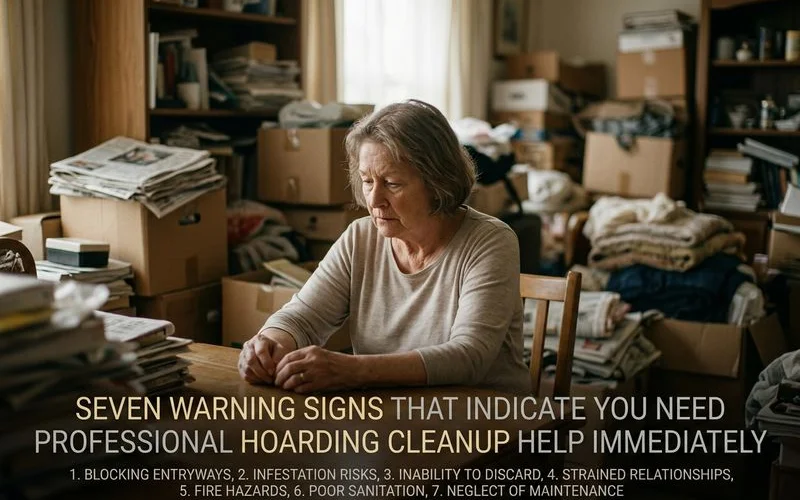
You know how quickly a spare room can turn into a catch-all storage space, but missing the 7 signs you need professional hoarding cleanup help can lead to serious safety risks.
Our team at Summerville Hoarding Cleanup sees this exact scenario unfold constantly across the South Carolina Lowcountry. A March 2025 report in Psychology Today shows that up to 6 percent of older adults struggle with clinical hoarding disorder.
That statistic highlights a critical truth. The progression from simple clutter to a dangerous living environment happens so slowly that families often miss the warning signs.
Let’s look at the data, what it is actually telling us about home safety, and explore seven clear indicators that it is time to bring in professional help.
Sign 1: Rooms in the Home Can No Longer Be Used for Their Intended Purpose
When the guest bedroom becomes a floor-to-ceiling storage unit, the home stops functioning properly. The Institute for Challenging Disorganization outlines this exact scenario in their Clutter-Hoarding Scale. Reaching Level 3 on this five-level scale means two or more rooms have lost their primary function entirely.
Our professionals evaluate these specific spatial losses during every initial walk-through. A 2024 United States Senate Special Committee on Aging report revealed that 80 percent of older adults with hoarding behaviors struggled to move about their own homes. The same study noted that 70 percent could not even sit on their living room sofa.
Losing functional space forces occupants into smaller and smaller living areas. A single room holding extra boxes is normal, but losing access to essential areas signals a severe problem.
Ask yourself these functional questions:
- Is the kitchen stove clear for safe food preparation?
- Can every bed in the home actually be slept in?
- Are bathroom sinks and tubs fully accessible?
- Can you walk through hallways without turning sideways?
- Do doors open fully without hitting debris?
If you answered no to these questions, scheduling a professional assessment is a smart next step. We can provide honest guidance on whether specialized cleanup is necessary or if a simpler intervention makes sense.
Sign 2: There Are Blocked Exits or Pathways
Blocked exits elevate a cluttered house into a life-threatening environment. First responders frequently encounter narrow walking trails, known in the industry as “goat paths,” winding through piles of possessions. These tiny walkways severely restrict escape during a fire or medical emergency.
Our local emergency teams see the devastating results of blocked pathways every day. Accumulated combustible materials like cardboard and vintage clothing act as fuel, causing fires to spread rapidly.
According to the Columbia Fire Department in South Carolina, between 30 and 40 percent of local house fires occur in homes with significant stockpiling.
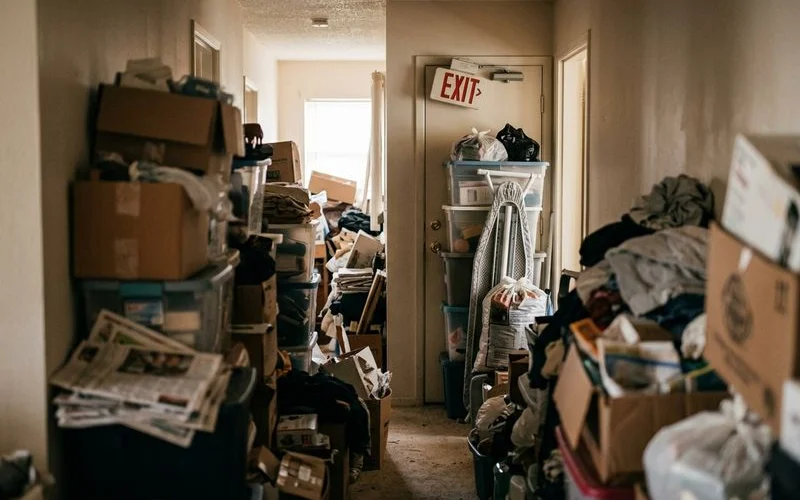
Firefighters wearing heavy gear simply cannot pass through 18-inch goat paths to rescue trapped occupants. Any exit that requires squeezing past debris is a critical safety violation that you must address immediately.
Our emergency hoarding services tackle these exact life safety hazards head-on. Crews clear blocked doors and windows within 24 to 48 hours to restore safe egress. We prioritize establishing these clear pathways to buy your family time while a comprehensive cleanup plan is developed.
Sign 3: You Notice Health-Related Symptoms
Air quality degrades significantly when belongings block HVAC returns and cover floor vents. The resulting stagnant air creates a perfect breeding ground for severe indoor allergens. Homeowners rarely connect their sudden physical illnesses to the surrounding environment.
Our crews routinely uncover dangerous fungal growths hiding behind towering stacks of boxes. In the humid South Carolina Lowcountry, restricted airflow combined with trapped moisture allows molds like Aspergillus and Stachybotrys chartarum to thrive undetected. These spores circulate constantly, causing serious reactions for anyone breathing the air.
Watch for these environment-related health indicators:
- Chronic wheezing not tied to a known medical condition
- Unexplained skin rashes or contact dermatitis
- Frequent sinus infections lasting for months
- Digestive issues from unsanitary food preparation areas
- Severe aggravation of pre-existing asthma
Medical professionals confirm that living in restricted, dusty spaces severely impacts physical health. A 2024 Harvard University health report highlights that poor sanitation in hoarding scenarios directly correlates with increased respiratory distress. Removing the excess material is the only way to permanently eliminate the source of the allergens.
We utilize specialized equipment to identify and remediate these hidden biological hazards. Thorough cleaning restores healthy airflow and immediately improves the indoor air quality for the occupants.
Sign 4: The Situation Has Been Getting Worse Despite Attempts to Improve It
Many well-meaning families attempt a massive weekend cleanout to fix the problem. This approach almost always backfires because it treats the symptom rather than the underlying cause. True hoarding disorder is an official diagnosis in the Diagnostic and Statistical Manual of Mental Disorders, Fifth Edition (DSM-5).
Our field experience shows that forced cleanouts often cause severe emotional distress and lead to rapid re-cluttering. The American Psychiatric Association reports that 75 percent of individuals with hoarding disorder also suffer from co-occurring conditions like major depressive disorder or severe anxiety. Expecting a person battling these conditions to organize thousands of items alone is entirely unrealistic.
Indicators That Self-Management Is Failing
Individual efforts usually hit a wall when the psychological attachment to the items overrides the desire for a clean space.
Look for these specific warning signs of failed interventions:
- Cleared dining room tables refill with mail within days
- Donation bags sit in the hallway for months without leaving
- The occupant experiences panic attacks during sorting attempts
- Family cleanup days end in screaming matches or tears
- The total volume of possessions continues to increase annually
We focus on creating a physically safe environment without causing unnecessary psychological harm. Professional teams work efficiently to remove the physical burden, providing a blank slate for the individual to begin therapeutic recovery.
Sign 5: Utility Systems or Appliances Have Stopped Working
Buried mechanical systems represent a massive financial and safety risk for the homeowner. When technicians cannot physically reach a water heater or electrical panel, basic maintenance completely stops. A simple $50 repair easily morphs into a catastrophic failure.
Our damage assessment teams frequently find ruined flooring caused by hidden plumbing leaks. Restoration pricing data from 2025 shows that repairing water damage and structural rot in hoarded homes easily adds $5,000 to $15,000 to the total bill. Catching these issues early saves thousands of dollars in secondary repairs.
The Dangers of Blocked Systems
Ignoring broken appliances forces the occupant to rely on unsafe alternatives. Space heaters replace central air, and buckets replace functional toilets.
Critical utilities affected by severe clutter:
- Blocked HVAC units causing indoor temperatures to exceed 95 degrees
- Inaccessible electrical panels delaying emergency power shutoffs
- Buried water heaters leaking unnoticed into the subfloor
- Smothered kitchen stoves creating immediate fire hazards
- Broken refrigerators leading to severe foodborne illnesses
We have seen countless South Carolina homes suffer severe heat damage because the air conditioning condenser was suffocated by yard debris. Fixing the utility requires first clearing a massive physical path for the repair technician.
Sign 6: Pest Infestations Are Present
Pests seek out undisturbed, dark spaces with abundant food sources. Towering piles of cardboard boxes offer the perfect breeding ground, as insects like German cockroaches actually feed on the glue holding the boxes together. Once established, an infestation multiplies rapidly behind the wall of possessions.
Our removal crews frequently discover massive nests hidden deep within compacted debris. Rodents and insects chew through drywall and wiring, creating significant fire hazards and structural decay.
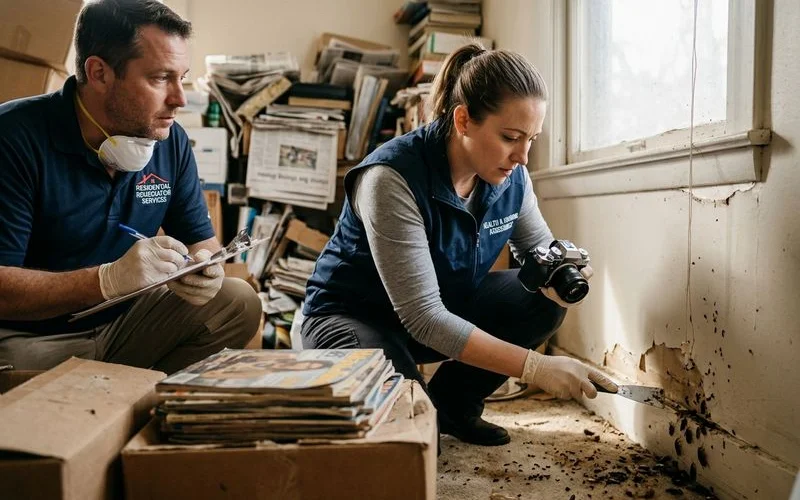
Exterminators legally require 18 to 24 inches of clear space along every baseboard to apply chemical treatments safely and effectively.
Calling a standard exterminator before clearing the room will not solve the problem. Exterminators simply cannot spray a room if they cannot reach the perimeter walls to target the actual infestation points.
We coordinate directly with licensed exterminators throughout the Charleston area to time the cleanup perfectly. Removing the physical clutter eliminates the nesting material, allowing the pest control experts to permanently eradicate the insects.
Sign 7: There Are Biohazard Conditions in the Home
Discovering bodily fluids, animal waste, or rotting food completely changes the scope of a cleanup project. These materials introduce dangerous pathogens into the air and require specialized chemical sanitation. Household bleach is entirely inadequate for neutralizing concentrated biological contaminants.
Our biohazard and hazard remediation teams strictly follow state and federal safety guidelines. The South Carolina Department of Environmental Services (SCDES) enforces Regulation 61-105, which dictates exactly how infectious waste must be packaged, transported, and destroyed. Violating these disposal laws can result in massive fines for the property owner.
The Reality of Biological Hazards
Exposure to concentrated bacteria and viruses poses an immediate threat to anyone entering the structure.
Common biological hazards requiring certified removal:
- Accumulated pet feces and urine saturating the subfloor
- Human waste stored in bottles or buckets
- Decomposing animal remains hidden under debris
- Black mold colonies spanning entire walls or ceilings
- Bloodborne pathogens on discarded personal items
We mandate the use of full OSHA-compliant Personal Protective Equipment (PPE), including respirators and hazmat suits, for all biological work. Professional decontamination ensures the property is legally safe for human habitation once again.
What to Do If You Recognize These 7 Signs You Need Professional Hoarding Cleanup Help
Taking the first step in the recovery process feels overwhelming, but a structured approach minimizes the anxiety. Approaching a family member requires immense patience, empathy, and a focus on safety rather than aesthetics.
Our project managers suggest starting with a simple, non-judgmental conversation about trip hazards. The International OCD Foundation highly recommends pairing the physical house cleaning with specialized cognitive behavioral therapy to prevent future relapses.
Practical Steps for Moving Forward
Having a concrete plan keeps the process moving without causing unnecessary emotional spikes.
Actionable steps to begin the recovery process:
- Document safety hazards: Note blocked exits or broken utilities to share with the cleanup company.
- Understand the investment: National 2025 pricing data shows professional cleanups average $1 to $5 per square foot based on hazard levels.
- Verify specialized credentials: Hire a whole-house hoarding cleanup crew trained in psychological sensitivity, not standard junk haulers.
- Schedule an onsite evaluation: A walk-through provides an accurate timeline and scope of work.
- Assemble a support system: Connect the occupant with a local therapist specializing in hoarding behaviors.

We always prioritize the mental well-being of the homeowner during the initial consultation. Establishing trust is the absolute most important factor in a successful restoration project.
Help Is Available in the Lowcountry
Living in a hazardous environment is not a permanent sentence. Help is readily available across Summerville, Charleston, North Charleston, Goose Creek, and Moncks Corner.
Our local specialists provide confidential, zero-pressure assessments to give you a clear path forward. The team explains all your options so you can make an informed decision for your family.
Call us today at (843) 517-7097 to schedule your free property evaluation. Taking action after spotting the 7 signs you need professional hoarding cleanup help protects your loved one and preserves the value of the home.
For more information about the clutter scale, read our complete guide to understanding the 5 levels of hoarding disorder.