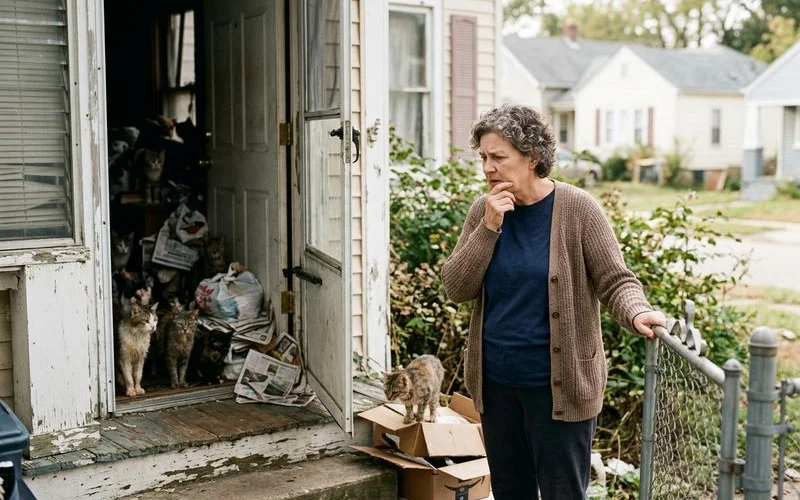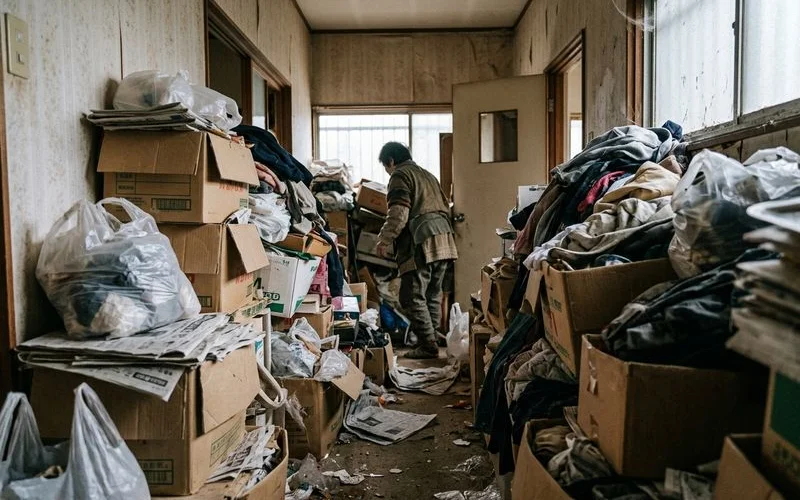
Our professional service team at Summerville Hoarding Cleanup has walked into hundreds of homes where a manageable collection quietly crossed the line into a crisis. Families frequently tell us they missed the tipping point because the items accumulated so gradually.
That gradual progression makes the dividing line incredibly hard to spot.
We provide emergency hoarding services for residents across the Charleston area who find themselves facing sudden deadlines or severe safety threats. The reality is that waiting too long often triggers steep financial penalties, structural damage, or life-threatening health risks.
Let’s examine the specific warning signs, review the data behind these hazards, and outline practical steps to protect your home.
Immediate Life Safety Threats
The most clear-cut emergencies involve direct threats to human life. These scenarios require intervention within hours or days rather than weeks.
Blocked Exits and Fire Hazards
Our experience shows that blocked pathways represent the single most critical risk factor in any home. The National Fire Protection Association (NFPA) recently reported that hoarding behaviors contribute to 24 percent of all preventable residential fire deaths in the United States. That statistic is alarming because hoarding households only make up about 0.25 percent of all fire incidents.
We constantly remind clients that a fire in a cluttered home behaves very differently than a standard house fire. In 90 percent of normal residential fires, the blaze stays contained to the room of origin. Local fire departments in Summerville and Goose Creek find that in hoarded homes, that containment rate drops to just 40 percent. The extreme fuel load of stacked paper and clothing causes the fire to spread much faster and burn significantly hotter.
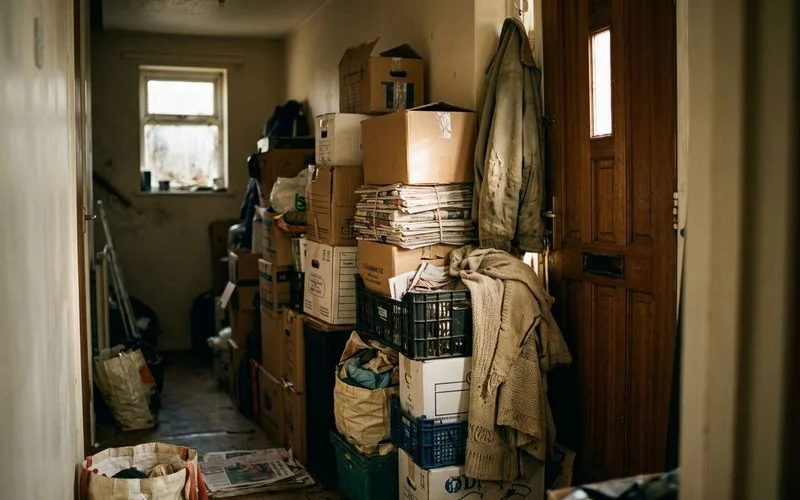
Our crews know that blocked exits completely eliminate the chance for a rapid escape. A person who normally exits their home in under 30 seconds may find escape impossible when narrow pathways and piles of belongings block the doors. Firefighters attempting a rescue face those exact same obstacles.
This is an emergency when:
- Any exterior door cannot be opened fully due to items blocking the hinges or frame.
- Windows that could serve as emergency exits are obstructed.
- The pathway to the nearest exit requires turning sideways or climbing over debris.
- Smoke detectors have been removed because of frequent false alarms from dust.
Structural Failure Risk
We often assess property damage that homeowners have completely underestimated. Standard modern building codes, like the International Residential Code, dictate that residential floors are designed to support a live load of 40 pounds per square foot (psf) in living areas. Bedrooms are generally rated for just 30 psf.
Our cleanup teams have cleared rooms packed floor-to-ceiling with dense materials like magazines and canned goods, which easily exceed those weight limits by thousands of pounds. This excess weight causes noticeable floor bounce or “deflection” long before a catastrophic collapse occurs. South Carolina’s Lowcountry homes frequently sit on pier-and-beam foundations, making them highly vulnerable to this overloading if moisture has already weakened the joists.
| Residential Area | Standard Safe Live Load | Estimated Severe Hoarding Load |
|---|---|---|
| Standard Bedrooms | 30 lbs per square foot (psf) | 80+ lbs per square foot (psf) |
| Main Living Areas | 40 lbs per square foot (psf) | 100+ lbs per square foot (psf) |
This is an emergency when:
- Floors feel noticeably soft or bouncy when walked on.
- You can see visible sagging in the floor or ceiling drywall.
- Cracks in the walls are widening over time.
- Doors that previously closed perfectly now stick or will not latch.
Medical Emergencies
We classify an environment as a medical emergency when emergency medical technicians cannot safely access a patient. The Institute for Challenging Disorganization (ICD) uses a five-level Clutter-Hoarding Scale to assess environmental risks. Homes reaching Level 4 or Level 5 on this scale feature blocked entrances and unusable pathways that make it physically impossible for responders to bring a stretcher inside.
Our staff has witnessed situations where elderly residents fell and remained trapped for over 24 hours because the clutter prevented them from reaching a phone. The crucial “Golden Hour” of medical response vanishes when paramedics must tunnel through debris to reach a patient. Emergency personnel responding to calls in the Summerville area report that tight pathways force them to improvise on the scene, directly delaying critical care.
This is an emergency when:
- The occupant has mobility limitations that make navigating the space dangerous.
- Medical equipment like oxygen concentrators cannot be used properly.
- Emergency responders would have difficulty transporting the occupant out of the house.
- The occupant experiences health symptoms related to the living conditions.
Health and Environmental Hazards
Some crises develop at a slower pace but eventually cross a threshold where continued habitation becomes a severe health risk.
Biohazard Contamination
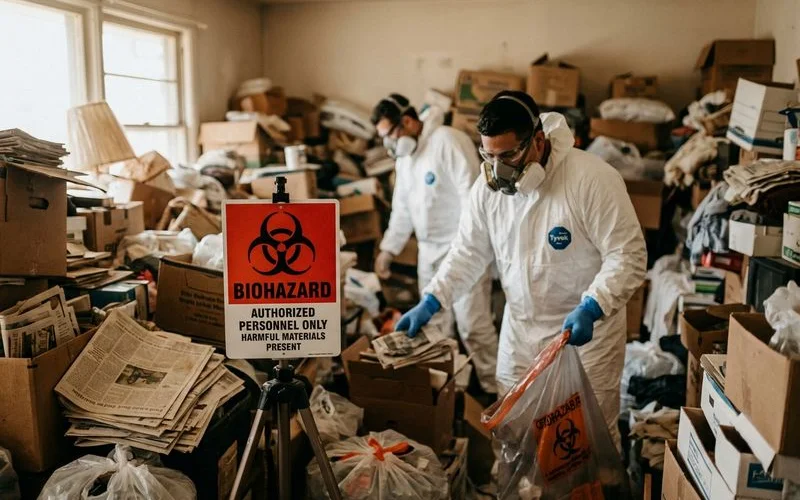
We handle severe biological contamination on a regular basis, and the health impacts are severe. The situation becomes urgent when a property develops the specific hazards outlined in our detailed guide on what qualifies as biohazard in hoarding situations. The ICD Clutter-Hoarding Scale specifically identifies Level 5 environments as having zero ventilation, active rot, and severe pest infestations.
“Those in a Level 5 house live in outright unsafe conditions. On the daily they are coming in contact with zero ventilation, mold and mildew, pet waste, infestations, and decay.”
Our cleanup specialists know that these specific conditions cause progressive, irreversible respiratory damage to occupants. Human waste accumulation and decomposing organic material create an environment that requires immediate professional remediation. Vulnerable individuals, especially children or seniors with weakened immune systems, must be relocated immediately.
Utility Failures
We consider the loss of essential utilities a fast track to an emergency declaration. Without electricity, a home in the South Carolina summer heat can exceed safe temperature limits in a matter of hours. A disabled HVAC system fails to ventilate the space, trapping hazardous ammonia fumes from animal waste and accelerating the growth of dangerous mold spores.
Our standard protocol prioritizes rapid response when water service is disconnected, as the inability to flush toilets creates an immediate sanitation crisis. Remaining perishable food spoils rapidly without refrigeration, instantly compounding the existing bacterial risks.
This is an emergency when:
- Electricity has been disconnected during summer months.
- Water service has been lost and the occupant has no alternative sanitation.
- The HVAC system has failed and the home cannot be ventilated.
Legal and Regulatory Triggers
Property issues frequently escalate into crises simply because external authorities step in and impose strict legal deadlines.
Code Enforcement Actions
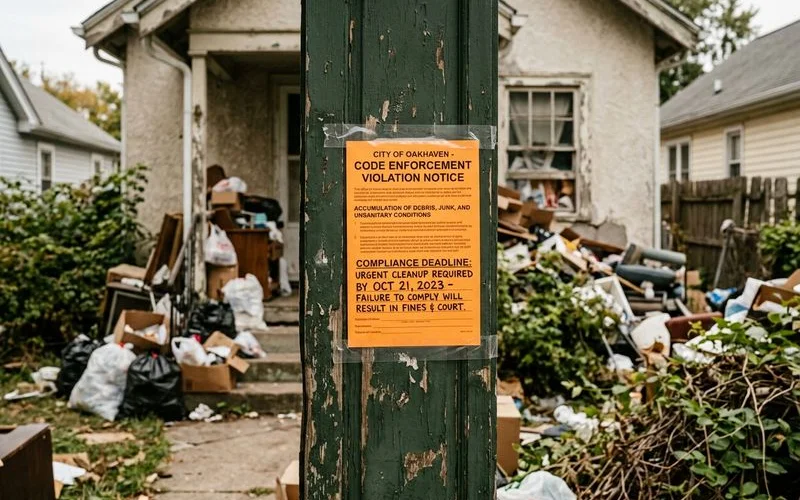
We frequently receive panicked calls from homeowners who just found a violation notice taped to their front door. Municipalities across the Charleston area, including North Charleston and Goose Creek, enforce strict housing codes to maintain neighborhood safety. Code enforcement officers typically issue a Notice of Violation giving the property owner 30 to 90 days to achieve compliance.
Our experience shows that ignoring these deadlines leads to daily accumulating fines and eventual property condemnation. The city may even hire municipal contractors to forcibly clear the property at the owner’s expense. These contractors are rarely trained in compassionate hoarding practices, and the city will place a heavy financial lien on the house to recover their costs.
Adult Protective Services Involvement
Our professionals often collaborate with families during active state investigations. Under the South Carolina Adult Protection Act, the Department of Social Services investigates non-criminal allegations of maltreatment, which heavily features self-neglect. The National Adult Protective Services Association lists cluttered pathways and living in squalor as top indicators of this self-neglect.
We help families demonstrate proactive compliance to case workers before the state decides to remove a vulnerable adult from their home. Taking immediate, documented action to clear hazards drastically improves the chances of a favorable investigation outcome.
Lease Violations and Eviction
We know that renters face an incredibly tight timeline when property managers discover a hoarded unit. South Carolina state law allows landlords to issue a 14-Day Notice to Comply for material health and safety violations under the lease agreement. If the tenant fails to correct the hazard within two weeks, the landlord can file for eviction in Magistrate Court.
Our teams work quickly to resolve these specific lease violations before the court issues a Writ of Ejectment. Once a judge signs that writ, law enforcement can legally remove the tenant and their belongings in as little as 24 hours.
Family Crisis Points
These emergencies do not always start with a formal legal notice or a visible physical hazard. A sudden family event can demand immediate intervention.
Impending Home Sale or Foreclosure
We frequently assist real estate agents and families staring down rigid financial deadlines. Bank-owned property inspections and scheduled closing dates cannot be negotiated or delayed. A property must be cleared out completely before a final walkthrough or a foreclosure auction can legally proceed.
Child or Elder Welfare Concerns
Our priority is always the safety of the most vulnerable family members. Current research indicates that between 2.5 and 6 percent of U.S. adults struggle with hoarding disorder, with the severity often increasing in individuals over age 70. Discovering that an elderly parent is living in an unsafe, Level 4 hoarded environment requires rapid, compassionate intervention to restore basic sanitation.
Death of the Occupant
We support grieving families who are suddenly burdened with clearing an estate. Probate proceedings, reverse mortgage obligations, and lease expirations dictate a strict timeline for emptying the residence. The emotional weight of sorting through a lifetime of possessions is massively amplified when dealing with hidden biohazards or structural risks.
Taking Emergency Action
If you face an urgent situation in the Summerville, Charleston, or surrounding Lowcountry area, follow these structured steps to regain control.
- For immediate life safety threats: Call 911 first. If someone is trapped, injured, or in immediate danger, emergency services should be your very first call.
- For code enforcement deadlines: Contact a professional cleanup team the exact same day you receive the notice. Initiating the cleanup process immediately proves to authorities that you are taking the deadline seriously.
- For health emergencies: Relocate the affected person to a safe, climate-controlled environment while the property is assessed.
- For family crises: Take a deep breath and recognize that you do not have to solve everything at once. Focus on clearing the primary pathways and bathrooms first.
Our emergency hoarding services at Summerville Hoarding Cleanup are designed specifically to handle these high-pressure, time-sensitive cleanups. A highly trained crew can typically mobilize within 24 to 48 hours to secure the most critical safety issues while working compassionately with the people involved.
Contact us at (843) 517-7097 to discuss your specific timeline and situation. Do not wait until the situation spirals completely out of your control.
We offer a free, confidential assessment to determine the fastest path back to a safe home. There is no charge for this initial conversation, and there is no situation we have not seen before.